


The Forest Landowners Guide to the Federal Income Tax
Chapter 3 - Tax Planning
| Topics: | ||
| The Planning Team | Planning Implications | |
| Developing Integrated Plans | Substantial Initial Investment | |
| Introduction | Long Preproductive Period | |
| Advantages of Timber Investments | Tax Considerations When Forest Land is Acquired | |
| Estate Planning Role | Tax Considerations When Selling Timber |
Achieving the maximum potential from your forest property requires the development and implementation of integrated forest management, estate, and financial plans. Depending on the complexity of your circumstances, and your willingness to become personally involved in the timber, legal, financial, and tax aspects of forest management, you may need the technical expertise of a consulting forester, an accountant, a lawyer, or other investment advisors. The role of each of these individuals is discussed in the context of the planning considerations that should be made.
Introduction The financial objective for your timber activity should be to maximize the after-tax return on the funds you have committed for the benefit of whomever you desire. If your objective is merely to enjoy the woodland, your activity most likely constitutes a hobby and should be treated accordingly for tax purposes. Personal enjoyment and profitability are not incompatible goals, but any expenditures you make that do not contribute directly and materially to profitability may not receive favorable tax treatment. Thus, your forester should draft the forest management plan so that the prescriptions recommended and their impact on profitability are clearly stated and understood. Similarly, your accountant should advise on the recording of expenses in your accounts so you can distinguish between profit-oriented and pleasure- oriented outlays.
Tax planning does not mean tax evasion. Rather, it means arranging your affairs so that you pay only the tax required by law, which takes into account the advantage of any conservation incentives included in the law. Your accountant may suggest tax deferral, shifting of tax burdens among family members, and timing of cash flows using the cash method of accounting as legal planning strategies to minimize your taxes. Your accountant and attorney should be familiar with the forest management plan so that they can anticipate opportunities to assist you in making favorable tax adjustments in the timing of revenues and expenses.
A consistent tax strategy is important. You should evaluate your goals and the extent of your forest resources and decide if your operations constitute an investment or if they rise to the level of a business (see Chapters 5 and 12). Your accountant and attorney can assist you in making the determination that best fits your circumstances. Your records for reporting of income and deducting of expenses should then be handled accordingly
Advantages of Timber Investments
Timber investments are not, as a rule, considered tax shelters because, among other things, you cannot deduct more than your out-of-pocket investment in the activity In fact, many expenditures must be carried in a timber account for years before they can be recovered. Likewise, long-term borrowing on forest land is limited to institutions such as the Farm Credit Bank (formerly Federal Land Bank) and a few u companies that specialize in timber loans. Some commercial banks make short-term loans on forest property.
For a given level of risk, however, timber may increase the return to your overall investment portfolio. Because generally no tax is due until gain is recognized, the law favors investments that yield appreciation rather than annual income. Timber provides a means of tax deferral – that is, the value accumulation through growth and product change is not recognized until the timber is harvested. It appreciates in value through growth in volume, in-growth into more valuable product categories (for example, pulpwood into sawtimber), increase in quality, and long-run real (in excess of inflation) price increases. Thus, woodlands with adequate growing stock appreciate in value over time and require very little management attention other than monitoring the timber stocking levels and protection from insects, disease, and trespass. Your forester should be routinely involved in this process.
Timber property may serve as an inflation hedge because it provides considerable flexibility in harvest timing. This is illustrated in Figure 3-1 with a stand that can be harvested within 3 to 5 years prior to or after an optimum rotation determination, with a minimum amount of potential income foregone (a detailed discussion is found on page 15). Furthermore, income realization can be timed to meet cash needs or tax considerations because, within limits, cutting can be delayed or accelerated – thus affecting income and/or tax liability in a given tax year. The marginal tax rates for the years to which or from which income is shifted must be considered.
For highly appreciated timber property (low basis), recognition of income often can be deferred for income tax purposes until retirement. Short-term cash needs can be accommodated more effectively by borrowing with the woodland as collateral than by a sale. Although timber is somewhat illiquid, it may provide a financial reserve to meet cash needs. Both your forester, who can determine the optimum timing of timber cutting for given assumptions about cost and revenues, and your tax accountant, who can advise as to the tax impacts of various management alternatives, should be involved in this process.
Timber can be used as the component of a portfolio designed to accumulate wealth for transfer to heirs. You may want to arrange your affairs to minimize liability for estate and other transfer taxes. Thus, forest land often is a good candidate for a short- term trust or intergenerational joint ownership. Forest property also is a good candidate for a family gifting program to reduce the gross estate value to less than the Federal estate tax threshold. There are other advantages for using timber as a gift, including situations where it is desired to spread income tax liability among family members. Gifts, however, have one key disadvantage in addition to loss of control. Gifted property retains the donor's basis, which often is quite low, as opposed to the step-up in basis for property passed at death. If a gift tax has been paid, the donee's basis sometimes may be increased by part of the amount of tax paid. Your attorney and accountant should be consulted on the tax consequences of specific actions and on their overall impact on your estate planning.
The tax liability of a family can be minimized in many cases by shifting income from family members in higher tax brackets to those in lower brackets through gifts of income-producing property. The Uniform Gifts to Minors Act facilitates income shifting. Under the act, a gift of intangibles can be made to a minor, with the parent who made the gift serving as custodian. State law allows the custodian to manage the assets provided there is no commingling of the child's income with the parent's property. Such planning is limited by the tax liability calculation for a child under the age of 14. Your accountant can help evaluate the tax implications of various gift alternatives.
Forest land estates may qualify for special use valuation (Section 2032A of the Internal Revenue Code (Code)), deferral and extension of estate tax payments (Section 6166), and the family business deduction (Section 2057). Timber, as a renewable resource, often can provide funds to meet transfer tax liabilities without having to liquidate nonrenewable family business assets. Your forester can assist in the valuation of woodland assets for special use valuation and your attorney or tax accountant, or both, can assist in making the appropriate elections.
Various timber characteristics lend themselves to specific planning implications. Deferral of income is an example. The trees generally increase in volume (quantity) and value annually, but the increase in value is not recognized until the trees are harvested.
Substantial Initial Investment - The acquisition of woodland generally requires a substantial initial investment with little possibility of immediate cost recovery, unless merchantable timber is acquired. For example, purchase of forest land includes a bare land value at an average cost of $500 per acre. If not stocked, reforestation costs can vary from $100 to $300 per acre depending on site index (productivity), operability, and other factors. To minimize the time over which such costs must be carried, you should ensure that the proper portion of the available basis is allocated to each asset account (Chapter 5), amortize qualified reforestation expenditures (Chapter 5), and claim the reforestation investment tax credit (Chapter 5).
The costs allocated to timber basis that cannot be amortized usually will be recovered only as the timber matures and is sold (see Figure 3-1).
Figure 3-1 illustrates several points. First, land expectation value (LEV, the net present value for a perpetual series of timber crops) calculations are plotted for a 6-percent cost of capital (the landowner's alternative rate of return) at 5-year intervals for loblolly pine on an average site in the South. The inputs are establishment costs of $200 per acre, annual property tax and management costs of $7 per acre, no-thin harvest revenues based on prices of $29 per cord for pulpwood and $315 per MBF, Scribner log rule, for sawtimber, with yields estimated using PCWTHIN, 1 a computer growth and yield model for loblolly pine developed by the growth and yield cooperative of the Virginia Tech Department of Forestry. For these assumptions the optimum rotation length is 30 years, which yields an LEV of $396 per acre.
Second, the liquidation curve shows the merchantable volume that could be harvested over time from an acre planted to loblolly pine times the prevailing price for these particular assumptions. Timber production is assumed to be the highest and best use for the land. Even in this simple example, timber production is a capital intensive undertaking that involves land, establishment costs necessary to obtain adequate growing stock, and annual operating costs that must be committed to for long periods of time.
Finally, the internal rate of return is determined in this special case for the assumed inputs and the 30- year rotation. The IRR of 8.87 is used to compound the establishment costs and annual management costs forward where they are plotted to form the cost (C/I) curve shown in Figure 3-1. Similarly, harvest revenues could be discounted subtracting the annual management cost to get an income (C/I) curve. This is an imaginary curve that traces the value of land and timber at any intermediate point in the rotation between establishment and harvest. Note that LEV maximizes returns to the land while IRR maximizes returns to invested capital. If IRR rather than LEV had been used to determine rotation length, the optimum rotation would have been approximately 27.5 years. The cost/income curve and liquidation curve reach a point of tangency at age 30 in Figure 3-1 because for this example IRR was calculated for the 30-year rotation indicated by LEV.
Figure 3-1. Timing of investment, annual management expenses, and harvest revenues, per acre.
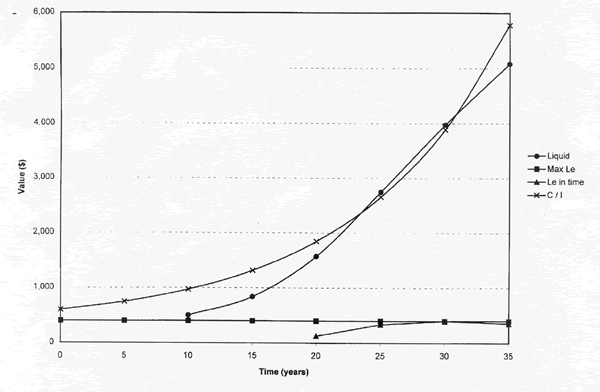
On either side of the optimum rotation in Figure 3-1, the C/I curve, which represents the potential income for the optimum, deviates only moderately in vertical distance from the liquidation curve, which represents the actual revenue that would be generated everywhere except at the optimum. This illustrates graphically that there is a decision window of several years to schedule a harvest. Because foregone potential income is small within 3 to 5 years of the optimum rotation, you can schedule a harvest within that period to meet other personal goals with only a small sacrifice in potential income.
Good forest valuation and accounting information is necessary for effective planning. Your forester can generate the valuation information, and your accountant can see that the proper allocation is made to the original basis in the appropriate capital accounts.
Long Preproductive Period - Consider structuring your timber activity to allow the deduction of qualified expenses against other (nontimber) income where appropriate. This usually involves organizing the woodland as a business, with material participation on your part (Chapter 5). Early payment of expenses at the end of the tax year accelerates the benefit of the deduction. Otherwise, try to acquire forest land with a good distribution of timber age classes.
TAX CONSIDERATIONS WHEN FOREST LAND IS ACQUIRED
It may be helpful for you to develop and maintain in your files a management plan documenting your intention to manage the property for profit, and to include an estimate of projected profit. Your forester should be able to make this projection routinely as part of the management or estate plan. Establish accounts to which the costs of acquisition – or values associated with acquisition if the property is inherited – are allocated according to the relative fair market value of each component of the property acquired. Do so while the information is readily at hand (see Chapters 5 and 15). You should file for property tax relief if special forest property tax laws exist in your State.
Both your forester and tax accountant should be involved in identifying and incorporating these opportunities in ways that are most advantageous with regard to your long-term goals. Your forester and accountant should coordinate the timing of the revenues as well as the treatment of all costs, as discussed above. Finally, planning is a dynamic activity that must keep abreast of your family situation, the economy, and tax law changes. Your advisors should be included in all phases of the process to help you fully realize your goals for your woodland property.
TAX CONSIDERATIONS WHEN SELLING TIMBER
Maximize after-tax income by taking all allowable deductions against timber sale proceeds. Report net timber income as a long-term capital gain if it qualifies (Chapter 6). Unlike ordinary income, capital gains are not subject to the self-employment tax (Chapter 10). Also, if you are retired, capital gains - do not count toward the amount of income you can receive before your Social Security benefits are reduced (Chapter 10). Consider deferring receipt of a portion of the sale proceeds, but only if the resulting tax saving exceeds the opportunity cost of not having use of the deferred funds (see Chapters 2 and 10).